
Product and process
L.E.L. Control Unit (Lower Explosive Limit Control)
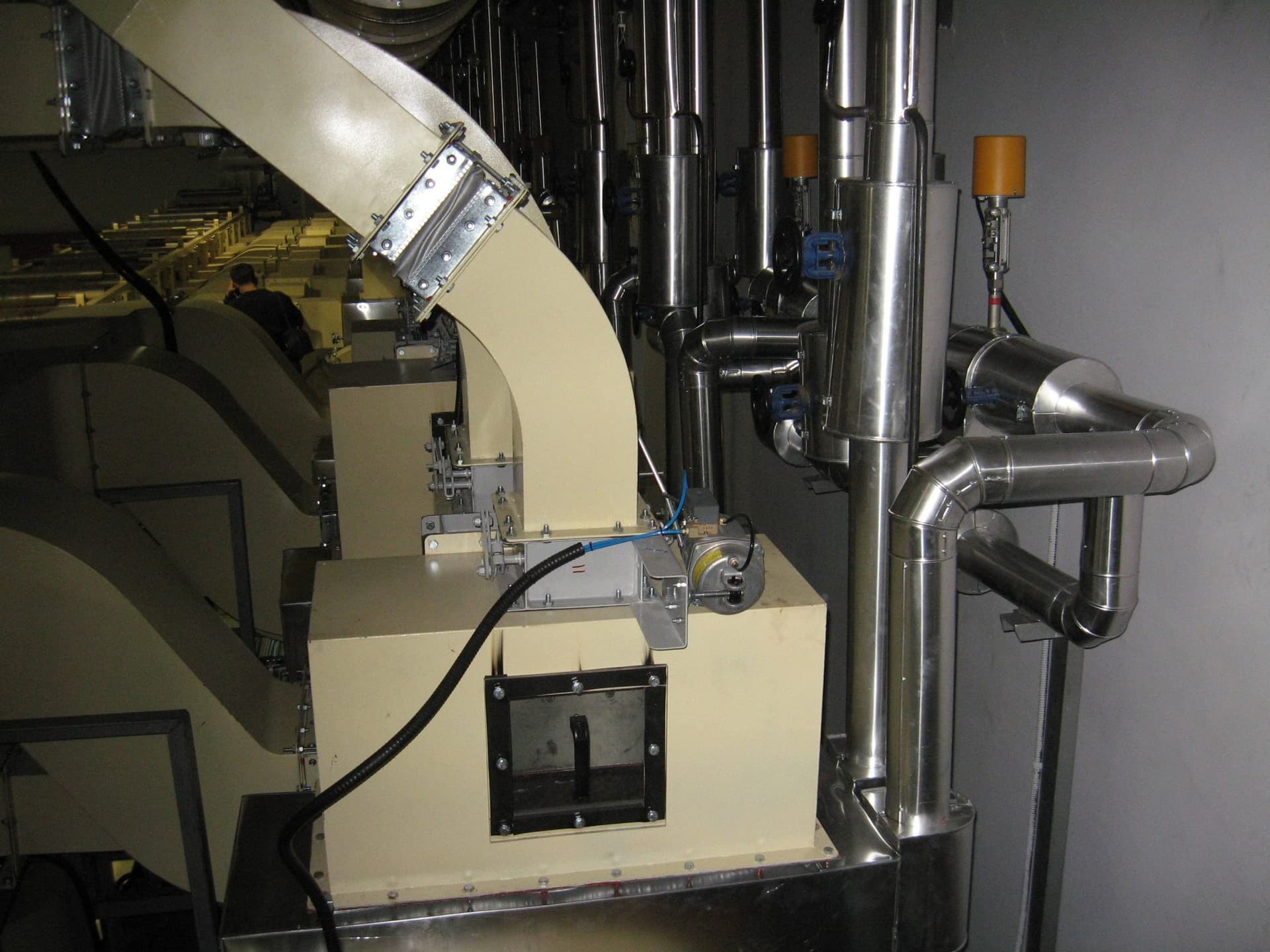
An L.E.L. control unit continuously measures the solvent vapour concentration in drying ovens and exhaust ducts and keeps it at a safe percentage of the lower explosive limit. Without measurement, safety can only be achieved with a very high air flow. With measurement and automatic control the exhaust flow is matched to the real solvent load, and the heating energy and the size of the recovery plant shrink together.
Reference values
Explosive limits of common printing solvents
- Toluene
- Lower limit 1.1% by volume, upper limit 7.1%; flash point 4 °C[D-01]
- Ethyl acetate
- Lower limit 2.0% by volume, upper limit 11.5%; flash point −4 °C[D-02]
- n-Hexane
- Lower limit 1.1% by volume, upper limit 7.5%; flash point −22 °C[D-03]
Values are for room conditions. The lower explosive limit falls as temperature rises; the value that applies at dryer temperature is taken into account separately in the design. For solvent mixtures the limit is calculated from the composition.
The difference
A dryer without measurement and a dryer with it
Without continuous measurement
- The only way to ensure safety is to supply the air flow calculated for the worst case at all times: highest speed, widest print, highest ink consumption.
- In real production this scenario rarely occurs. Most of the time the dryer runs with far more air than it needs.
- All of this air is heated and then discharged through the exhaust. A large share of the heating energy goes into heating surplus air, not into evaporating solvent.
- Because the exhaust is dilute, the recovery plant behind it is sized large.
With continuous measurement and automatic control
- The concentration is known at every moment. Exhaust and fresh-air flows are adjusted to the real solvent load.
- Less air is heated and discharged; the dryer’s fuel or thermal oil consumption drops.
- The same solvent is carried in less air. The fan, duct and adsorber sizes of the recovery plant shrink, and the activated-carbon capacity is used more efficiently.
- Concentration values are logged. When a limit is exceeded the system intervenes by itself.
How it works
The measurement, control and safety chain
Sampling
Samples are drawn continuously from the dryer zones and the exhaust duct. The sample line is heated to prevent condensation and kept as short as possible; the delay time is part of the safety calculation.
Analysis
The analyser measures the total solvent concentration in the sample and expresses it as a percentage of the lower explosive limit. The analyser type and calibration gas are chosen for the solvents used on the line.
Control
The PLC adjusts the exhaust and fresh-air dampers and the fan speed according to the measured value. The aim is to keep the concentration within the safe operating range and as steady as possible.
Safety
The measurement also feeds safety thresholds that are independent of the control loop. When a threshold is exceeded, the staged intervention shown in the table below takes over.
Logging and verification
Concentration, damper positions and alarm events are recorded. The analyser is verified with calibration gas at regular intervals; the verification records serve as evidence in audits.
Alarm logic
Staged intervention scenario
| Stage | Condition | System response |
|---|---|---|
| Normal operation | Concentration within the target range | Dampers and fan speed are adjusted continuously; energy consumption is at its lowest |
| Pre-alarm | Concentration above the first threshold | Fresh air opens fully, exhaust goes to maximum flow, the operator is warned |
| High alarm | Concentration above the second threshold | Solvent input is stopped (the printing or coating unit disengages), heating is cut, ventilation continues |
| Measurement fault | Analyser, sample line or flow fault | The system behaves as if there were no measurement: it switches to maximum air flow and raises an alarm |
Failing to the safe side on a measurement fault is the system’s most important design principle.
The energy link
What is gained when the exhaust flow drops?
A dryer’s heat demand has two components: the heat needed to evaporate the solvent and the heat needed to bring the incoming air up to working temperature. The first is fixed by production. The second is directly proportional to the air flow and, on dilute lines, makes up a large share of the total.
Every reduction in exhaust flow therefore means a similar reduction in heating load. The gain depends on the line’s current flow, working temperature and production profile. Quoting a general percentage would be misleading; during the survey the existing flows are measured and the expected saving is calculated with your plant’s own data. If your dryers are heated by a thermal oil system, the gain shows directly in the heater load.
The second gain is on the investment side. A solvent recovery plant is sized by air flow. When L.E.L. control is installed ahead of the plant, the plant that follows is smaller and cheaper. That is why we treat the two systems together in new plant projects.
Application
Is your line suitable for L.E.L. control?
- DurumRotogravure or flexo press with a multi-unit dryer
- Suitable. A measurement point is planned for each unit or group of units; because the solvent load changes a lot between products, the gain is high.
- DurumLaminating and coating line with a single long dryer
- Suitable. The dryer zones are monitored separately; the first zones, where the solvent load is highest, are decisive.
- DurumAdhesive tape coating line
- Suitable. Because toluene and hexane have low lower explosive limits, the safety contribution of measurement is high too.[D-03]
- DurumSeveral solvents used alternately on the line
- The analyser and the calculation are chosen to cover all solvents in use; the component with the lowest limit governs the safety calculation.
- DurumExisting machine delivered with its manufacturer’s safety concept
- The change affects the machine’s risk assessment. The retrofit is carried out together with the machine manufacturer’s documentation and an authorised conformity assessment.
Scope
What does Yeşil Çevre Makine provide?
We install L.E.L. control units as part of our recovery plants or as stand-alone systems retrofitted to existing lines. The PLC, operator interface and software are prepared in-house and integrated with your line’s existing automation[C-01].
- On-site measurement of the existing exhaust flows and solvent loads
- Definition of the number of measurement points and the analyser type
- Supply and installation of the sample line, analyser cabinet, dampers and fan drives
- Programming of the control and safety scenario, communication with the line automation
- Commissioning, calibration procedure and operator training
Frequently asked questions
Frequently asked questions about the L.E.L. control unit
What does L.E.L. mean?
L.E.L. stands for Lower Explosive Limit. It is the lowest concentration at which a flammable vapour can form an ignitable mixture in air. For toluene, for example, this value is 1.1 percent by volume.
What does an L.E.L. control unit do?
An L.E.L. control unit continuously measures the solvent concentration in drying ovens and keeps it at a safe percentage of the lower explosive limit. This lets the exhaust air flow be reduced safely, which lowers heating energy and the size of the recovery plant.
Does L.E.L. control save energy?
Yes. Dryers without continuous measurement run at a high air flow set for the worst case, and all of this air is heated and discharged. With L.E.L. control the air flow is matched to the real solvent load. The saving is specific to the line and is calculated from measurements taken during the survey.
Can an L.E.L. control unit be added to an existing press?
Yes. The units can be retrofitted to running rotogravure, flexo, laminating and coating lines. Because the change affects the machine’s safety concept, the retrofit is carried out together with the machine documentation and a risk assessment.
What happens if the analyser fails?
The system fails to the safe side. When the measurement is lost, the control behaves as if there were no measurement: it switches to maximum air flow and raises an alarm. Production can continue in safe mode without measurement until the fault is cleared, or it is stopped.
Sources and method
What the information on this page rests on
This page was prepared by Yeşil Çevre Makine using the company’s product catalogue, photographs from its site installations and the public sources listed below. Information that is a company statement is marked as such in the text. Project-specific values (capacity, emission, recovered quantity) are determined for each plant at the survey and design stage.
Official regulation and standards
Primary sources; links go to the official publication pages.
- R-08EN 1539:2015 Dryers and ovens, in which flammable substances are released. Safety requirementsCEN (Avrupa Standardizasyon Komitesi) · Ekim 2015 · Accessed: 18 Eylül 2026 · Standart metni ücretlidir; bu sayfada yalnızca kapsamına atıf yapılmıştır
Technical reference data
Public data sources used for solvent properties.
- D-01NIOSH Pocket Guide to Chemical Hazards: TolueneABD Hastalık Kontrol ve Korunma Merkezleri (CDC), NIOSH · Son gözden geçirme 30 Ekim 2019 · Accessed: 18 Eylül 2026
- D-02NIOSH Pocket Guide to Chemical Hazards: Ethyl acetateCDC, NIOSH · Son gözden geçirme 30 Ekim 2019 · Accessed: 18 Eylül 2026
- D-03NIOSH Pocket Guide to Chemical Hazards: n-HexaneCDC, NIOSH · Son gözden geçirme 30 Ekim 2019 · Accessed: 18 Eylül 2026
Company statements and documents
Statements resting on these sources are Yeşil Çevre Makine’s own; they have not been verified by an independent body.
- C-01V.O.C. Solvent Geri Kazanım Tesisleri kataloğu (Türkçe)Yeşil Çevre Makine · 2022 · Accessed: 18 Eylül 2026 · Şirket belgesi
Request a site survey and pre-feasibility for your line
Tell us the solvent, the approximate consumption and the line. Our engineers call you to clarify the need and, where useful, plan on-site measurements.
What we ask for
- Solvent type
- Consumption or air flow
- Sector and line type
- Project stage
To reach us directly: +90 506 839 88 57 · info@yesilcevmak.com