
Product and process
Solvent Drying Systems with Molecular Sieve
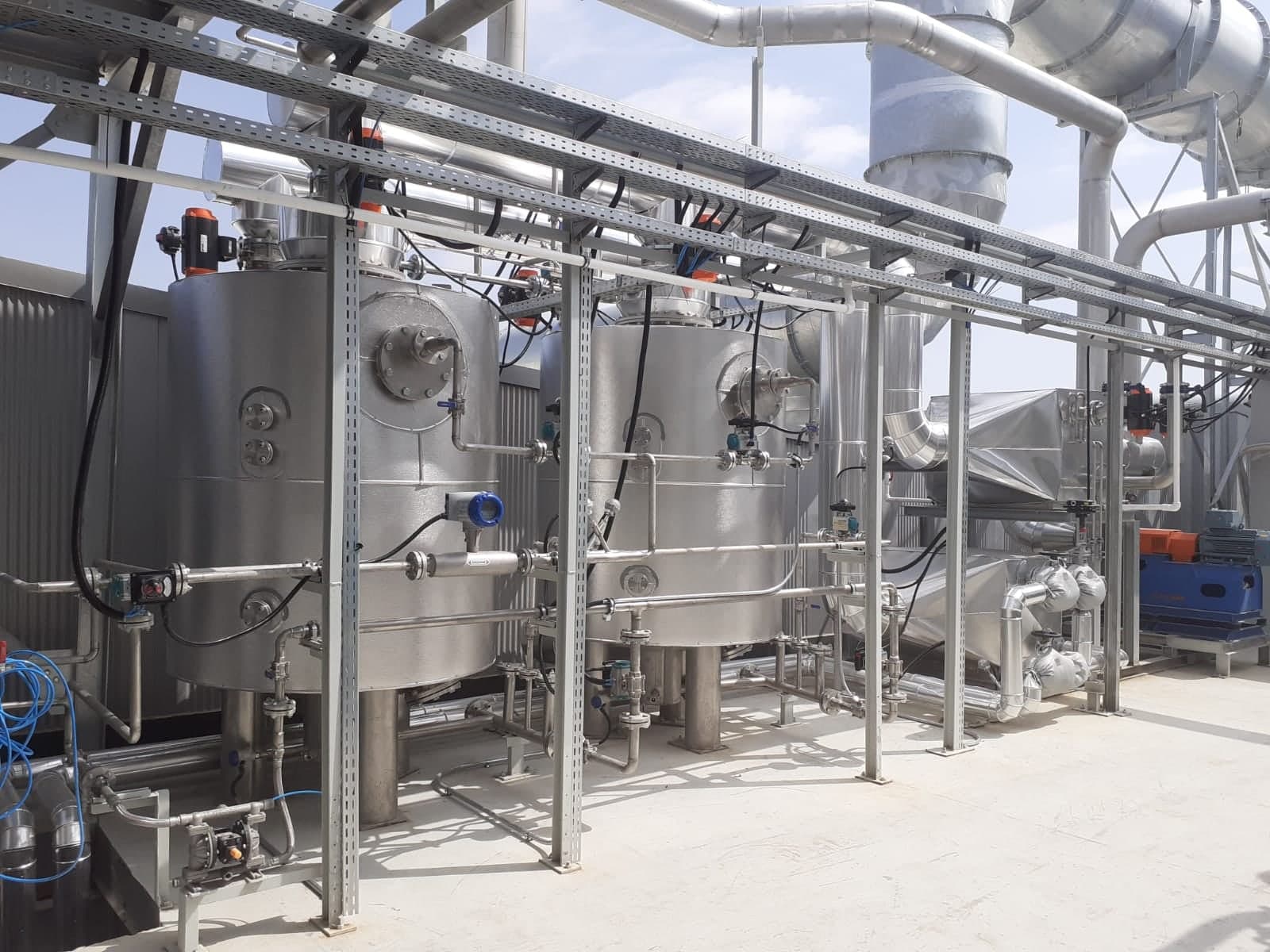
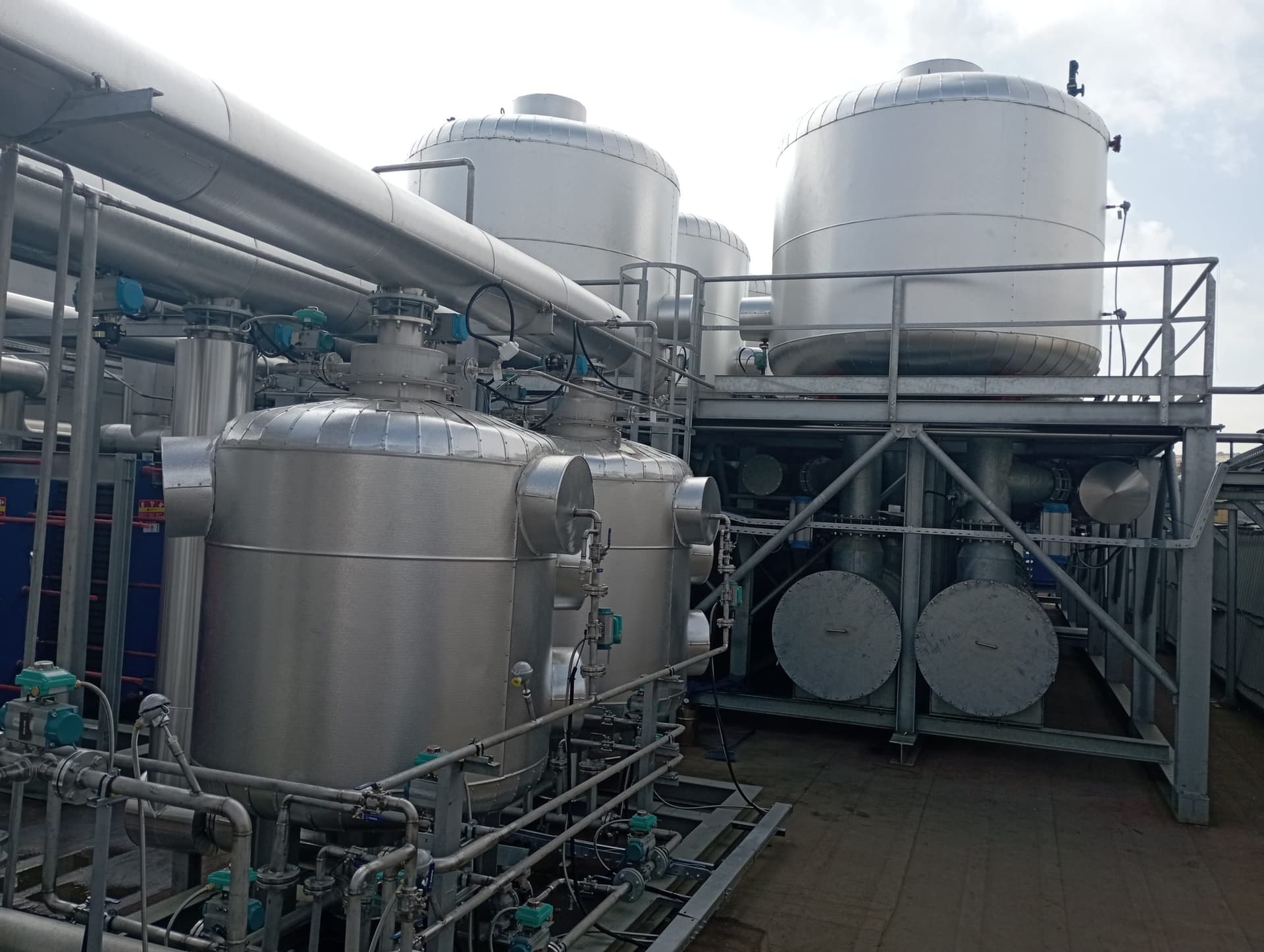
A molecular sieve system selectively holds the water in a solvent on zeolite beds and delivers dry solvent. Because recovered ethyl acetate, ethanol and isopropyl alcohol mix with water and part of it cannot be removed by distillation, reusing these solvents at printing and coating quality usually needs a drying step. Yeşil Çevre Makine designs and manufactures zeolite-bed molecular sieve tanks for each project.
The problem
Why is there water in recovered solvent, and why does it matter?
In activated-carbon recovery plants the carbon beds are usually regenerated with steam, and the air being treated carries moisture of its own. The condensed solvent therefore contains some water.
Toluene and hexane do not mix with water; they separate by themselves in the decanter.[D-01] Ethyl acetate, on the other hand, is partly soluble in water,[D-02] and ethanol and isopropyl alcohol mix with water in all proportions. These solvents condense together with water and cannot be cleaned by a simple phase separation.
Water in the solvent used for printing and lamination affects drying speed, the ink’s film formation and the performance of the laminating adhesive. For recovered solvent to replace fresh solvent, its water content has to be brought down to the level your product accepts.
Comparison
Why can distillation not remove all the water?
| Criterion | Distillation | Molecular sieve |
|---|---|---|
| Separation principle | Difference in boiling point | Difference in molecule size |
| Azeotropic mixtures | Separation stops at the azeotropic composition; a certain water content cannot be reached | Unaffected by the azeotrope; the water molecule enters the pore, the solvent does not |
| Energy | The whole stream is evaporated | Only the saturated bed is regenerated |
| Most efficient range | High water content | Low water content (final drying) |
| Place in the line | First: the distillation unit | Then: the final drying step |
Place in the line
The purification line for water-miscible solvents
- Wet solventrecovery plant outlet
- Distillationmost of the water
- Molecular sieveremaining water
- Dry solvent tanknitrogen-blanketed
- Production lineprinting, lamination
Working principle
How does zeolite select water?
Zeolite is a crystalline aluminosilicate with uniform, very small pores. The pore diameter is fixed during manufacture. The types used for solvent drying have pores that let small water molecules in while keeping the larger solvent molecules out. As wet solvent passes through the bed, the water is held in the pores and the solvent leaves dry.
The amount of water a bed can hold is limited. When saturated it is heated, releases the water it holds and is ready for use again. The zeolite type, grain size and bed height are chosen for the solvent, the flow and the target water content.
Operating cycle
Drying and regeneration run in turn
Drying
Wet solvent is passed through the zeolite-bed tank. The water content at the outlet is monitored; when the value starts to rise above the target, the bed is saturated.
Tank changeover
The flow is switched automatically to the standby tank. Drying continues without interruption.
Regeneration
The saturated bed is heated and releases the water it holds. Because the outgoing stream contains a small amount of solvent it is not discarded but returned to the head of the line.
Cooling and standby
The bed is cooled to operating temperature and waits ready for the next cycle. Cycle times are managed by the automation system.
Benefits
What does the molecular sieve add to the line?
- Selectivity
- Zeolite holds water and passes solvent; no solvent is lost during drying
- Beyond the azeotrope
- Water levels that distillation cannot reach are achieved
- Energy
- Only the bed is heated instead of evaporating all of the solvent
- Continuity
- Several tanks work in turn; the supply to production is not interrupted
- Bed life
- Zeolite is regenerated many timesLife depends on the cleanliness of the solvent and the regeneration conditions; carry-over of oil and resin shortens it.
- Product quality
- Solvent with controlled water content gives predictable results in printing and lamination
Selection guide
Does your line need a molecular sieve?
- DurumIf you recover only toluene or hexane
- Usually not. These solvents do not mix with water; a decanter is sufficient.
- DurumIf you recover ethyl acetate, ethanol or isopropyl alcohol
- Most likely yes. The required water level depends on your product; the whole line is described in the ethyl acetate recovery guide.
- DurumIf you use a moisture-sensitive laminating adhesive
- The water content target is tighter; bed size and cycle time are set accordingly.
- DurumIf you already have a recovery plant but cannot use the solvent in printing
- A molecular sieve can be added later as a stand-alone unit. The water content and composition of the existing solvent are analysed first.
- DurumIf the solvent carries oil, resin or particles
- Distillation or filtration is needed first; dirty solvent can block the zeolite pores permanently.
Design
The inputs that set the sizing
Molecular sieve tanks can be installed as a stand-alone unit, but in most projects they are designed as part of a single closed loop together with adsorption, distillation and nitrogen-blanketed storage. The tanks, piping and automation are manufactured in-house[C-01].
- Solvent type and composition: set the zeolite type.
- Hourly flow: sets the bed cross-section.
- Inlet and target water content: set the zeolite quantity and cycle time.
- Heating source: existing thermal oil, steam or electricity for regeneration.
- Operating pattern: sets the number of tanks and the redundancy.
Frequently asked questions
Frequently asked questions about molecular sieve systems
What is a molecular sieve?
A molecular sieve is an adsorbent, such as zeolite, with very small uniform pores that separates molecules by size. In solvent drying it holds the small water molecules and lets the larger solvent molecules pass.
Which solvents is a molecular sieve used for?
Molecular sieves are used mostly to dehydrate water-miscible, azeotrope-forming solvents such as ethyl acetate, ethanol and isopropyl alcohol.
How long does a zeolite bed last?
A zeolite bed is regenerated by heating and releases the water it holds. A properly operated bed is regenerated many times and used for a long period. Its life depends on the cleanliness of the solvent and the regeneration conditions.
Why is a molecular sieve needed when there is distillation?
Some solvents form an azeotrope with water, and distillation cannot go below a certain water content. The molecular sieve selectively holds this remaining water, producing solvent with a water content low enough for printing and coating.
Can a molecular sieve be added to an existing plant?
Yes. Molecular sieve tanks can be added as a stand-alone unit at the outlet of an existing recovery and distillation line. The water content and composition of the existing solvent are analysed first.
Sources and method
What the information on this page rests on
This page was prepared by Yeşil Çevre Makine using the company’s product catalogue, photographs from its site installations and the public sources listed below. Information that is a company statement is marked as such in the text. Project-specific values (capacity, emission, recovered quantity) are determined for each plant at the survey and design stage.
Technical reference data
Public data sources used for solvent properties.
- D-01NIOSH Pocket Guide to Chemical Hazards: TolueneABD Hastalık Kontrol ve Korunma Merkezleri (CDC), NIOSH · Son gözden geçirme 30 Ekim 2019 · Accessed: 18 Eylül 2026
- D-02NIOSH Pocket Guide to Chemical Hazards: Ethyl acetateCDC, NIOSH · Son gözden geçirme 30 Ekim 2019 · Accessed: 18 Eylül 2026
Company statements and documents
Statements resting on these sources are Yeşil Çevre Makine’s own; they have not been verified by an independent body.
- C-01V.O.C. Solvent Geri Kazanım Tesisleri kataloğu (Türkçe)Yeşil Çevre Makine · 2022 · Accessed: 18 Eylül 2026 · Şirket belgesi
Request a site survey and pre-feasibility for your line
Tell us the solvent, the approximate consumption and the line. Our engineers call you to clarify the need and, where useful, plan on-site measurements.
What we ask for
- Solvent type
- Consumption or air flow
- Sector and line type
- Project stage
To reach us directly: +90 506 839 88 57 · info@yesilcevmak.com