
Product and process
Nitrogen-Blanketed Solvent Storage Systems
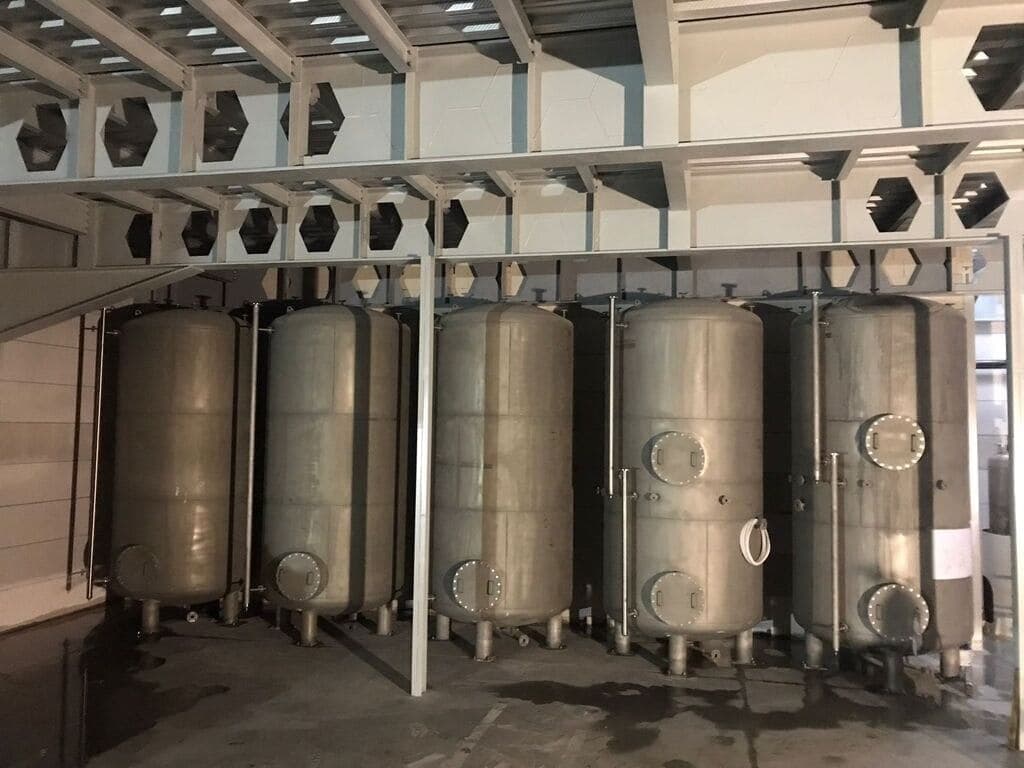
A nitrogen-blanketed solvent storage system keeps flammable solvent in fully closed tanks and fills the space above the liquid with nitrogen instead of air. With no oxygen in the tank, no ignitable vapour–air mixture can form; the solvent does not evaporate to the atmosphere and does not pick up moisture. Yeşil Çevre Makine designs, manufactures and commissions the tanks, nitrogen regulation, filling and transfer lines and instrumentation for each plant.
Why nitrogen
The difference between a freely vented tank and a nitrogen-blanketed tank
In storage open to the atmosphere
- Air enters as the tank empties. Solvent vapour mixes with air above the liquid, and for most solvents this mixture is within the flammable range.
- As the tank fills, air saturated with solvent vapour is pushed out. Every filling is a product loss and a V.O.C. emission.
- Humid air entering the tank dilutes the solvent. For hygroscopic solvents such as ethyl acetate and alcohols this directly affects print quality.
- Solvent odour and vapour exposure arise in the storage area.
In nitrogen-blanketed storage
- Nitrogen is supplied as the tank empties. With no oxygen in the headspace, no ignitable mixture can form.
- The tank is fully closed and held under slight pressure. The solvent does not escape to the atmosphere.
- The solvent does not touch humid air; it does not pick up water or oxidise. The quality of recovered and dried solvent is preserved in storage.
- The gas displaced during filling is vented under control or routed to the recovery line.
System components
A storage system is more than a tank
| Component | Function | Design consideration |
|---|---|---|
| Storage tank | Holds the solvent in a fully closed volume | Material chosen for the solvent: carbon steel, SS 304 or SS 316[C-01] |
| Nitrogen supply and pressure regulation | Supplies nitrogen as the tank empties, vents surplus gas as it fills; keeps the pressure within a narrow band | Regulator capacity is chosen for the highest emptying rate |
| Pressure–vacuum relief valve | Protects the tank against overpressure and vacuum | Worst-case flow including nitrogen failure and fire scenarios |
| Flame arrester | Prevents an external flame source from propagating into the tank | Type suited to the solvent group |
| Level, pressure and temperature measurement | Continuous monitoring, overfill and dry-run alarms | Independent high-level safety; data to the automation system |
| Filling and transfer line | Tanker unloading, supply to production, return from recovery | Pump selection, sealing, line slope and drain points |
| Earthing and equipotential bonding | Prevents static charge build-up during filling and transfer | The whole line, including the tanker connection point |
| Bund and drainage | Controlled containment of a possible leak | Bund capacity relative to tank volume; rainwater separation |
Closed loop
The solvent’s journey through the plant
When storage is designed together with the recovery plant and the distillation unit, the solvent circulates without ever touching the atmosphere.
Filling from the tanker
Fresh solvent is received into the fresh-solvent tank through an earthed tanker connection. The displaced nitrogen is vented under control.
Supply to production
A pump feeds solvent to the ink kitchen or the coating preparation area. As the tank empties, the nitrogen regulator keeps the pressure steady.
Return from recovery
Clean solvent from the recovery plant, the distillation unit and the molecular sieve is received into the recovered-solvent tank.
Segregation of dirty solvent
Dirty solvent from cleaning is collected in a separate tank and fed to the distillation unit. Fresh, recovered and dirty solvent never mix.
Monitoring
The level, pressure and transfer movements of all tanks are monitored on a single automation screen. The solvent balance, that is the quantities received, recovered and consumed, is recorded.
Design
The inputs that set the number and volume of tanks
The storage system is sized for the plant’s solvent logistics. Too small a tank means frequent tanker deliveries and a risk of stoppage; too large a tank means unnecessary investment and a higher fire load.
The layout is planned with the hazardous-area zone classification, the safety distances in fire regulations and the tanker manoeuvring area in mind. The suitability of the equipment for the explosive atmosphere is assessed under the relevant European directive.[R-11]
- Solvent types: a separate tank for each solvent; material and gasket selection per solvent.
- Daily consumption and delivery frequency: set the fresh-solvent tank volume.
- Recovery capacity: sets the volume of the recovered-solvent tank.
- Dirty solvent quantity: sets the feed tank of the distillation unit.
- Layout: above or below ground, open yard or indoors; safety distances.
- Existing nitrogen source: whether capacity is sufficient and whether back-up is needed.
Scope
Turnkey installation
Tank manufacturing, piping, automation and commissioning are carried out by Yeşil Çevre Makine from a single source[C-01]. The tanks are built at our facility in Kemalpaşa; site installation, pressure and leak tests, commissioning and operator training are done by our own team.
Converting an existing tank farm to nitrogen blanketing is also possible. In that case the tanks’ pressure rating, venting and safety equipment are examined; replacement or reinforcement is recommended for tanks that are not suitable.
Frequently asked questions
Frequently asked questions about solvent storage systems
What is a nitrogen-blanketed solvent tank?
A nitrogen-blanketed solvent tank is a fully closed storage tank in which the space above the liquid solvent is filled with nitrogen instead of air. With no oxygen in the tank, no ignitable vapour–air mixture forms and the solvent does not evaporate to the atmosphere.
Why is nitrogen used in solvent storage?
Nitrogen is a non-flammable gas that does not react with the solvent. By displacing the oxygen in the tank headspace it removes the ignition risk and prevents the solvent from picking up moisture or being lost by evaporation.
What are solvent tanks made of?
The tank material is chosen for the solvent to be stored and the purity expected. Yeşil Çevre Makine builds tanks in carbon steel and in SS 304 and SS 316 stainless steel.
Can the storage system be connected to a recovery plant?
Yes. Clean solvent from the recovery and distillation units is received directly into the nitrogen-blanketed tanks and fed back to the production line from there. All transfers are managed through one automation system.
Can my existing tanks be converted to nitrogen blanketing?
In most cases, yes. The tank’s pressure rating, venting and safety equipment are examined. Suitable tanks receive nitrogen regulation, a pressure–vacuum valve and instrumentation; replacement is recommended for unsuitable ones.
Sources and method
What the information on this page rests on
This page was prepared by Yeşil Çevre Makine using the company’s product catalogue, photographs from its site installations and the public sources listed below. Information that is a company statement is marked as such in the text. Project-specific values (capacity, emission, recovered quantity) are determined for each plant at the survey and design stage.
Official regulation and standards
Primary sources; links go to the official publication pages.
- R-11Directive 2014/68/EU (Basınçlı Ekipmanlar) ve Directive 2014/34/EU (ATEX)Avrupa Birliği, EUR-Lex · 2014 · Accessed: 18 Eylül 2026
Company statements and documents
Statements resting on these sources are Yeşil Çevre Makine’s own; they have not been verified by an independent body.
- C-01V.O.C. Solvent Geri Kazanım Tesisleri kataloğu (Türkçe)Yeşil Çevre Makine · 2022 · Accessed: 18 Eylül 2026 · Şirket belgesi
Request a site survey and pre-feasibility for your line
Tell us the solvent, the approximate consumption and the line. Our engineers call you to clarify the need and, where useful, plan on-site measurements.
What we ask for
- Solvent type
- Consumption or air flow
- Sector and line type
- Project stage
To reach us directly: +90 506 839 88 57 · info@yesilcevmak.com